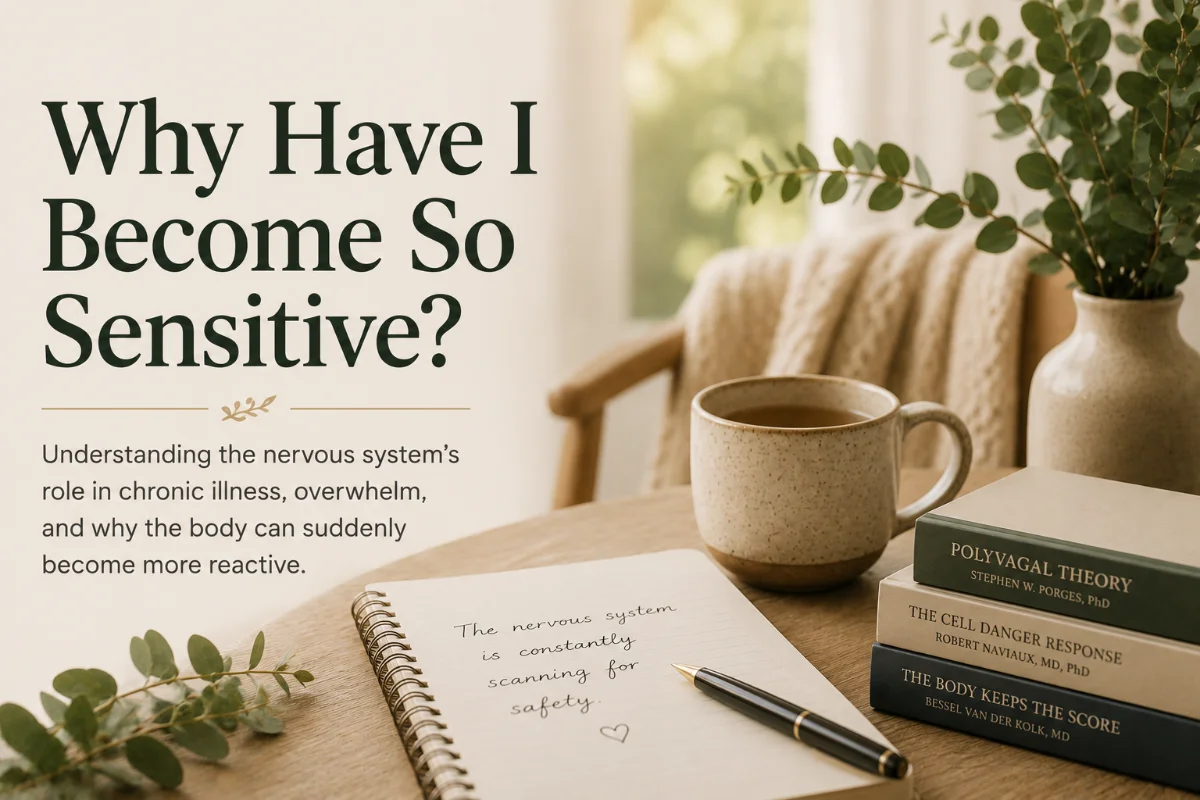
Why Have I Become So Sensitive? Understanding the Nervous System’s Role in Chronic Illness
Why medications, supplements, foods, stress, and everyday exposures can suddenly feel overwhelming — and what that may reveal about the nervous system.
“I can’t tolerate anything anymore.”
It’s one of the most common — and frustrating — statements I hear from patients.
People tell me they used to take medications without any difficulty, but now they experience side effects from even the smallest dose. Supplements that are supposed to help make them feel worse. Foods they enjoyed for years suddenly trigger bloating, fatigue, or headaches. Everyday exposures like perfume, cleaning products, bright lights, loud noises, or even a stressful day can leave them feeling completely overwhelmed.
After months or years of searching for answers, many begin to wonder:
“Is my body just falling apart?”
The answer is often no.
Over the past several years, my understanding of chronic illness has changed dramatically. While allergies, food sensitivities, detoxification challenges, and nutrient deficiencies certainly play important roles, I’ve come to appreciate that many people with chronic illness have something even more fundamental happening:
Their nervous system has become stuck in survival mode.
Your Nervous System Is Always Asking One Question
Your nervous system has one primary responsibility:
To keep you alive.
Every second of every day, your brain is asking one simple question:
“Am I safe?”
When the answer is yes, your body directs its resources toward growth, healing, digestion, hormone production, immune balance, learning, and healthy energy production.
When the answer is no, your priorities immediately change.
Your body begins preparing to survive.
This is exactly what should happen during a true emergency. If you’re running from danger, your body isn’t concerned about digesting lunch or repairing tissues — it redirects its energy toward protecting you.
The problem arises when that alarm system never completely turns off.
When Protection Becomes the Default
Our nervous systems evolved to help us survive short-term threats. Modern life, however, often exposes us to challenges that don’t simply disappear after a few minutes. Chronic infections, mold exposure, Long COVID, Lyme disease, surgery, concussions, emotional trauma, chronic stress, poor sleep, environmental toxins, and autoimmune disease can all send the same message to the brain:
“Something isn’t safe.”
Although these experiences are very different, the brain often interprets them in remarkably similar ways. Over time, the nervous system can become increasingly protective. Instead of responding only to genuine danger, it begins reacting to situations that were once completely normal.
Why Everything Suddenly Feels Like Too Much
I often ask patients to imagine that the brain has a giant volume knob.
Under healthy circumstances, the volume is set appropriately. Your brain responds strongly to real danger while filtering out harmless background noise.
When the nervous system becomes dysregulated, however, that volume gets turned up.
Suddenly, supplements seem “too strong.” Medications produce unexpected side effects. Foods trigger symptoms they never caused before. Perfumes become overwhelming. Exercise feels exhausting. Stress becomes intolerable. Even positive excitement can leave you feeling depleted.
Nothing about the outside world necessarily changed.
The sensitivity changed.
Understanding this concept can be incredibly reassuring because it helps explain why so many seemingly unrelated symptoms often appear together.
What Is Polyvagal Theory?
One of the most important advances in understanding the nervous system came from Dr. Stephen Porges, who developed Polyvagal Theory.
His work suggests that our nervous system is constantly scanning both our environment and our bodies for signs of safety or danger — a process called neuroception.
Most of this happens automatically.
When the brain detects safety, we feel calm, connected, curious, and resilient.
When it detects danger, it shifts us toward fight, flight, freeze, or other protective responses.
These responses are not weaknesses.
They are normal survival strategies.
The challenge comes when the nervous system continues acting as though danger is present long after the original threat has resolved.
The Cell Danger Response
The brain isn’t the only part of the body that responds to danger.
Every cell does too.
Research by Dr. Robert Naviaux introduced the concept of the Cell Danger Response, explaining that when cells perceive ongoing threat, they temporarily shift away from growth and repair toward protection.
One of the biggest players in this process is the mitochondria — the tiny structures inside nearly every cell responsible for producing energy.
When the body senses danger, mitochondria redirect energy toward survival. This response is intelligent and helpful in the short term. But if those danger signals persist, energy production declines, inflammation increases, healing slows, and many of the symptoms associated with chronic illness begin appearing.
The important message is this:
Your body is not malfunctioning. It is responding to the information it is receiving.
Why I Start with the Nervous System
This understanding has fundamentally changed how I approach functional medicine.
Years ago, I focused primarily on treating individual problems.
Today, I spend much more time asking a different question:
“What does this person’s nervous system need in order to feel safe enough to heal?”
That doesn’t mean gut health, hormones, detoxification, nutrition, chronic infections, or environmental toxins aren’t important. They absolutely are.
But I’ve found that those therapies often become far more effective once the body’s master control system begins recognizing safety again.
Teaching the Brain Safety
The encouraging news is that your brain is remarkably adaptable.
Scientists call this neuroplasticity, meaning your brain can build new pathways throughout your lifetime.
Just as it learned survival, it can also learn safety.
That usually doesn’t happen because of one supplement or one medication. Instead, it develops through repeated experiences that teach the nervous system a new pattern.
Depending on the individual, these experiences may include slow breathing, expressive journaling, spending time in nature, morning sunlight, restorative sleep, Emotional Freedom Techniques (EFT), nervous system retraining programs such as Primal Trust, BrainHarmony, BrainTap, vagus nerve support, meaningful relationships, gentle movement, and, for selected patients, ketamine-assisted therapy integrated with counseling and nervous system work.
Healing rarely depends on one dramatic intervention.
More often, it is the accumulation of many small experiences of safety that gradually retrain the brain.
A Different Way of Thinking About Healing
One of the biggest shifts I’ve made in my own thinking is that I’ve stopped trying to “fix” people.
Instead, my goal is to create the conditions in which their bodies can heal themselves.
Think about a broken bone.
We don’t actually heal it.
The body does.
Our job is to align it, protect it, and provide the environment it needs to recover.
Chronic illness is often much the same.
My role is to help remove obstacles, calm the nervous system, identify root causes, and create the conditions that allow your body’s remarkable healing capacity to do what it was designed to do.
There Is Hope
If you’ve become increasingly sensitive to medications, supplements, foods, chemicals, or stress, you’re not alone.
More importantly, there is a biologic explanation for why this happens.
Your body isn’t trying to make your life difficult.
It has been trying to protect you.
The encouraging news is that the same nervous system that learned to become highly protective can also learn to become more flexible, more resilient, and more capable of healing.
Understanding that process is often the first step toward getting your life back.
Want to Learn More?
If this topic resonates with you, I invite you to join my upcoming patient class, “The Nervous System: The Missing Link in Chronic Illness,” where we’ll take a deeper dive into nervous system regulation, Polyvagal Theory, the Cell Danger Response, and practical strategies you can begin using immediately to support your health.
You can also explore several related episodes of The Functional Edge Podcast. My conversations with Donald Grothoff and Dawson Church explore Emotional Freedom Techniques (EFT) from both practical and scientific perspectives. My interview with Dr. Diane Driscoll explains the important role of the vagus nerve in nervous system health. My conversation with Dr. Richard Monaco explores ketamine-assisted therapy and how it can help increase the brain’s flexibility, allowing people to move beyond deeply ingrained patterns of thinking. Later this month, I’ll also be releasing my interview with Dr. David Hanscom, whose work on chronic pain, expressive journaling, and nervous system healing has profoundly influenced the way I think about recovery.
One of the most important lessons I’ve learned in functional medicine is this:
Your body is not working against you — it has been trying to protect you.
Our goal isn’t to fight your body.
Our goal is to help it feel safe enough to heal.
I hope you’ll join us this month as we continue exploring one of the most exciting and rapidly evolving areas of medicine. I truly believe that understanding your nervous system is one of the most empowering steps you can take on your healing journey.
To your health,
Dr. Julia Ward
Balanced Body Functional Medicine